
 English
 Pусский
 Français
 العربية


tensile strength tester
A tensile strength tester is a precision instrument used to measure the mechanical properties of materials under tension. It is widely applied in quality control, research, and product development to evaluate how a material behaves when it is pulled apart. By applying a controlled force to a specimen until it deforms or breaks, the tester provides essential data such as tensile strength, elongation, yield point, and breaking force. These results help manufacturers and engineers determine whether a material meets required standards and is suitable for its intended use.The basic structure of a tensile strength tester usually includes a load frame, a grip system, a force measurement sensor, and a control unit. The specimen is fixed between two grips, one stationary and one moving. As the machine begins to stretch the sample at a constant speed, the sensor records the applied force and the amount of deformation. Modern testers often feature digital displays, computer software, and automatic data collection systems, which make testing more accurate and efficient.Tensile strength testers are used for a wide range of materials, including metals, plastics, rubber, textiles, paper, films, wires, and composite materials. In the plastics industry, for example, they are used to check whether molded parts or packaging films have sufficient strength and flexibility. In the metal industry, they help evaluate wire rods, sheets, and structural components. In textiles, tensile testing is important for understanding fabric durability and resistance to tearing. Because different materials have different mechanical characteristics, the tester can be configured with various load capacities, grip types, and test speeds.One of the key advantages of a tensile strength tester is its ability to provide objective and repeatable results. This is especially important in industries where product failure can lead to safety risks, performance problems, or customer complaints. By using standardized test methods, laboratories can compare results across different batches or production lines. This helps ensure consistency and supports continuous improvement in manufacturing processes.In addition to strength testing, many tensile strength testers can perform related tests such as compression, bending, peeling, and tear resistance. This multifunctional capability increases their value in laboratories and production environments. Some advanced models also support temperature-controlled testing, which is useful for evaluating materials under real working conditions.Ease of operation is another important feature. A well-designed tensile strength tester should have a user-friendly interface, stable performance, and simple calibration procedures. Safety features such as overload protection, emergency stop buttons, and protective covers are also necessary to prevent accidents during testing.Overall, a tensile strength tester is an essential tool for material evaluation. It helps users understand the strength, flexibility, and durability of different products, enabling better design, improved quality, and more reliable performance in practical applications.
Producto
Categoría:
-
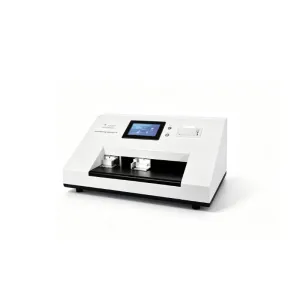
Probador automático inteligente de resistencia a la tracción
Su clasificación: Filter Paper & Media Testing InstrumentsVistas: 225Número:Tiempo de liberación: 2026-07-15 09:24:16El probador automático inteligente de resistencia a la tracción es un instrumento mecatrónico de precisión para medir la resistencia a la tracción, la resistencia a la tracción en húmedo y otros parámetros del papel y el cartón. Presenta un diseño horizontal que es estructuralmente compacto y completamente funcional. Su innovadora estructura de sujeción neumática garantiza un agarre de muestras perfectamente plana, eliminando el error humano común en las abrazaderas manuales, un diseño que llena un vacío en el mercado nacional. Impulsada por un servomotor importado, la velocidad de prueba se puede ajustar digitalmente de 1 a 420 mm/min. Tiene un rango de medición de 0 a 30 N, una precisión de 0,01 N y una resolución de hasta 0,001 N. A través de una gran pantalla táctil a color, muestra curvas de tracción en tiempo real y calcula automáticamente la fuerza de tracción, la resistencia a la tracción, el alargamiento, la longitud de rotura, la absorción de energía de tracción (TEA) e índices relacionados. Ofrece un potente procesamiento de datos, reinicio automático y puede imprimir informes estadísticos que incluyen promedio, desviación estándar y coeficiente de variación, lo que lo hace ideal para pruebas de calidad e investigación y desarrollo en las industrias de fabricación de papel, embalaje, pañuelos y hojas de tabaco.
Noticias
Categoría:
¡Sin resultados de búsqueda!
Caso
Categoría:
¡Sin resultados de búsqueda!
Video
Categoría:
¡Sin resultados de búsqueda!
Descargar
Categoría:
¡Sin resultados de búsqueda!
Reclutamiento
Categoría:
¡Sin resultados de búsqueda!
Productos recomendados
¡Sin resultados de búsqueda!



 Teléfono