
 English
 Pусский
 Français
 العربية


lab temperature humidity chamber
A laboratory temperature and humidity chamber is a controlled environmental testing device used to simulate a wide range of temperature and moisture conditions for scientific research, product development, quality assurance, and reliability testing. It provides a stable and programmable environment in which samples, components, or finished products can be exposed to specific climatic conditions for a defined period of time. By precisely controlling both temperature and relative humidity, the chamber helps researchers and engineers evaluate how materials and products perform under real-world or accelerated environmental stress.This type of chamber is widely used in industries such as electronics, pharmaceuticals, automotive, aerospace, materials science, and biotechnology. In laboratories, it is especially valuable for testing the durability, stability, and aging characteristics of samples. For example, electronic components may be checked for resistance to heat, moisture, corrosion, and condensation. Pharmaceutical products and biological samples may be studied to determine storage stability and shelf life. Plastic, rubber, metal, and coating materials can also be analyzed for changes in strength, appearance, or chemical properties when exposed to different climatic conditions.A typical laboratory temperature and humidity chamber is designed with an insulated inner workspace, heating and cooling systems, humidity generation and control mechanisms, and a digital control panel. Modern units often include advanced microprocessor-based controllers that allow users to set precise temperature and humidity values, program cycling tests, and monitor conditions in real time. Some chambers feature data logging functions, remote monitoring, and safety alarms to ensure accurate and reliable operation. The chamber may also be equipped with shelves, observation windows, and internal lighting to improve usability during testing.The working principle of the chamber is based on the continuous adjustment of air temperature and moisture content inside the test space. Heating elements raise the temperature when needed, while refrigeration systems or cooling circuits lower it. Humidity is typically controlled by introducing steam, atomized water, or other moisture sources, and then regulating it through sensors and feedback systems. High-precision sensors constantly measure the internal environment so that the control system can maintain stable conditions with minimal fluctuation.One of the key advantages of a laboratory temperature and humidity chamber is its ability to reproduce harsh or variable environmental conditions in a repeatable manner. This makes it possible to perform accelerated aging tests, condensation resistance tests, thermal cycling tests, and storage simulations. Such testing helps identify product weaknesses early in the development process, reducing the risk of failure in actual use. It also supports compliance with industry standards and regulatory requirements.In summary, a laboratory temperature and humidity chamber is an essential tool for controlled environmental testing. Its ability to accurately regulate temperature and humidity makes it indispensable for studying material behavior, verifying product reliability, and improving overall quality in many scientific and industrial fields.
Producto
Categoría:
-
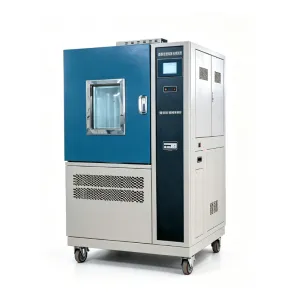
Constant Temperature and Humidity Chamber
Su clasificación: Paper Testing InstrumentsVistas: 181Número:Tiempo de liberación: 2026-08-10 08:44:20The Constant Temperature and Humidity Chamber series features precise temperature and humidity control systems, providing various environmental simulation conditions required for industrial research and biotechnology testing. The temperature range is 40℃ to +100℃, humidity range 30-98% R·H, temperature fluctuation ±0.5℃, and temperature deviation ±2℃. The temperature control system uses microcomputer single-chip technology for high precision. An imported temperature and humidity controller with programmable capability allows multi-parameter setting, with direct digital display of temperature and humidity values. The refrigeration system uses an imported compressor, and the humidity sensor uses imported components. The humidification unit employs an intelligent atomizer with a large-capacity supplementary water tank. The working chamber is made of stainless steel, and the outer cabinet is cold-rolled steel with electrostatic spraying. A large-view insulated vacuum tempered glass window facilitates observation. Standard configuration includes an illumination lamp. The equipment is widely applicable for sterility testing and stability checks in pharmaceuticals, textiles, and food processing, as well as raw material performance, product packaging, and product life testing of industrial products. It is an ideal environmental test device for research institutes, quality inspection agencies, and manufacturing enterprises.
Noticias
Categoría:
¡Sin resultados de búsqueda!
Caso
Categoría:
¡Sin resultados de búsqueda!
Video
Categoría:
¡Sin resultados de búsqueda!
Descargar
Categoría:
¡Sin resultados de búsqueda!
Reclutamiento
Categoría:
¡Sin resultados de búsqueda!
Productos recomendados
¡Sin resultados de búsqueda!



 Teléfono