
 English
 Pусский
 Français
 العربية


bending stiffness tester
A bending stiffness tester is a laboratory instrument used to measure the resistance of a material to bending or flexural deformation. It is widely applied in quality control, research and development, and product comparison for materials such as paper, cardboard, plastic films, textiles, nonwoven fabrics, leather, thin sheets, and other flexible or semi-rigid products. By evaluating how a sample responds when a controlled force is applied, the tester provides important data for understanding material rigidity, flexibility, and overall performance.The basic principle of a bending stiffness tester is to apply a force to a sample under standardized test conditions and record the force or moment required to produce a specific deflection or bending angle. Depending on the testing method, the sample may be clamped at one end and bent under its own weight, pressed by a moving probe, or placed on supports while a load is applied at the center. The instrument then calculates bending stiffness based on the relationship between applied force, displacement, and sample dimensions.Modern bending stiffness testers are usually equipped with a precision loading system, a sample fixture, a control unit, and a digital display or computer interface. The loading system ensures stable and accurate force application, while the fixture holds the sample in a consistent position to reduce operator error. Many models feature automatic calibration, programmable test speeds, and adjustable test parameters to meet different international standards. Some advanced versions also support data storage, curve analysis, and automatic report generation, making the testing process more efficient and reliable.One of the main advantages of a bending stiffness tester is its ability to provide objective and repeatable results. In manufacturing, even small differences in stiffness can affect packaging performance, product feel, printability, folding behavior, and durability. For example, in the paper industry, stiffness influences how well paper runs on high-speed machines and how a package maintains its shape. In textiles and nonwovens, bending stiffness affects drape, comfort, and hand feel. In plastics and films, it helps determine whether a material is suitable for folding, wrapping, or structural use.The tester is also valuable for comparing materials and optimizing formulations. Engineers and product developers can use stiffness data to modify thickness, composition, layering, or processing conditions in order to achieve the desired balance between flexibility and rigidity. Because test results are numerical and standardized, they can be used for incoming inspection, production monitoring, and product certification.In operation, a bending stiffness tester is generally simple to use. The operator prepares the sample according to the required size and conditioning conditions, places it in the test fixture, and starts the test. The instrument performs the measurement automatically and displays the result in units such as mN·m, N·mm, or other standardized values. To ensure accuracy, regular calibration and proper sample preparation are essential.In summary, a bending stiffness tester is an important tool for measuring the flexural properties of materials. It helps manufacturers, laboratories, and researchers evaluate product quality, improve design, and maintain consistent performance across production batches.
Producto
Categoría:
-
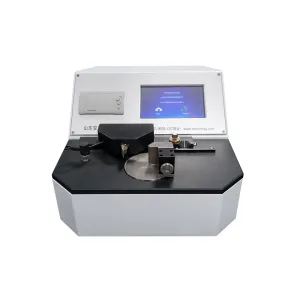
Probador digital de rigidez a la flexión
Su clasificación: Paper Testing InstrumentsVistas: 358Número:Tiempo de liberación: 2026-07-10 08:50:01El probador digital de rigidez a la flexión es un instrumento profesional para medir la rigidez a la flexión de papel y cartón. Es adecuado para determinar la rigidez a la flexión estática de diversos papeles, cartones y materiales de embalaje. Como pionero en la adopción de una interfaz hombre-máquina con pantalla curva LCD, este probador multifuncional permite ajustar libremente el ángulo de flexión entre 1° y 90°, cubriendo las pruebas estándar de 7,5° y 15°, así como la prueba de rigidez de pliegue de 90°. La longitud de plegado se puede seleccionar de 5 a 50 mm en pasos fijos (versión manual) o infinitamente ajustable de 5 a 60 mm (versión automática), y el tiempo de prueba se puede configurar de 3 a 35 segundos. El instrumento cuenta con puesta a cero automática, visualización de curva fuerza-tiempo-ángulo en tiempo real, estadísticas de medición automática e impresión. Después de la prueba, regresa a la posición inicial a alta velocidad con una velocidad de retorno ajustable de 0,55-20°/s. Todos los parámetros de rendimiento cumplen con los estándares GB/T 23144 y GB 22364-2018, lo que lo convierte en un instrumento de configuración estándar para pruebas de rigidez a la flexión en fábricas de papel, industrias de embalaje, institutos de investigación y agencias de inspección de calidad.
Noticias
Categoría:
¡Sin resultados de búsqueda!
Caso
Categoría:
¡Sin resultados de búsqueda!
Video
Categoría:
¡Sin resultados de búsqueda!
Descargar
Categoría:
¡Sin resultados de búsqueda!
Reclutamiento
Categoría:
¡Sin resultados de búsqueda!
Productos recomendados
¡Sin resultados de búsqueda!



 Teléfono