
 English
 Pусский
 Français
 العربية


bending resistance tester
A bending resistance tester is a specialized instrument used to evaluate the flexibility, durability, and structural integrity of materials when subjected to repeated or controlled bending forces. It is widely applied in quality control, research and development, and material performance testing across industries such as packaging, paper, textiles, plastics, leather, rubber, and composites. The primary purpose of this equipment is to determine how well a sample can withstand bending without cracking, breaking, losing strength, or showing permanent deformation.The basic working principle of a bending resistance tester is to apply a specified bending motion or load to a material sample and measure its response over time. Depending on the design, the tester may perform repeated flexing cycles or a single bending operation under controlled angles, speeds, and force conditions. The number of cycles a material can endure before failure, as well as any changes in appearance or mechanical properties, provides valuable data for assessing product quality and service life.A typical bending resistance tester consists of a test frame, clamping fixtures, a loading or bending mechanism, a control system, and a display or data output unit. The sample is securely fixed in position, and the machine applies bending according to preset test parameters. Modern models often feature digital controls, touch-screen interfaces, programmable test settings, and automatic result recording. Some advanced instruments can store test data, calculate averages, and generate reports for more efficient analysis.Bending resistance testing is important because many materials experience flexing during actual use. For example, packaging materials may be folded and handled repeatedly, paper products may be bent during printing or transportation, and plastic or rubber parts may be exposed to continuous motion in applications. By simulating these conditions in a laboratory environment, the tester helps manufacturers predict product performance, improve design, and reduce the risk of failure in real-world use.The results obtained from a bending resistance tester can be used to compare different materials, optimize thickness or composition, and verify compliance with technical standards. It also helps identify weaknesses such as brittleness, poor elasticity, internal defects, or inadequate manufacturing processes. In many cases, repeated bending tests are especially useful for products expected to maintain performance after long-term use or frequent handling.In addition to its practical value, the bending resistance tester contributes to product consistency and customer satisfaction. Reliable testing ensures that materials meet required mechanical properties before they are released to the market. This reduces waste, lowers production losses, and supports continuous improvement in material engineering.Overall, a bending resistance tester is an essential tool for measuring the bending performance of materials. With accurate testing, stable operation, and clear results, it plays a vital role in material evaluation, product development, and quality assurance.
Producto
Categoría:
-
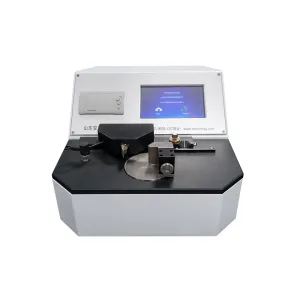
Probador digital de rigidez a la flexión
Su clasificación: Paper Testing InstrumentsVistas: 359Número:Tiempo de liberación: 2026-07-10 08:50:01El probador digital de rigidez a la flexión es un instrumento profesional para medir la rigidez a la flexión de papel y cartón. Es adecuado para determinar la rigidez a la flexión estática de diversos papeles, cartones y materiales de embalaje. Como pionero en la adopción de una interfaz hombre-máquina con pantalla curva LCD, este probador multifuncional permite ajustar libremente el ángulo de flexión entre 1° y 90°, cubriendo las pruebas estándar de 7,5° y 15°, así como la prueba de rigidez de pliegue de 90°. La longitud de plegado se puede seleccionar de 5 a 50 mm en pasos fijos (versión manual) o infinitamente ajustable de 5 a 60 mm (versión automática), y el tiempo de prueba se puede configurar de 3 a 35 segundos. El instrumento cuenta con puesta a cero automática, visualización de curva fuerza-tiempo-ángulo en tiempo real, estadísticas de medición automática e impresión. Después de la prueba, regresa a la posición inicial a alta velocidad con una velocidad de retorno ajustable de 0,55-20°/s. Todos los parámetros de rendimiento cumplen con los estándares GB/T 23144 y GB 22364-2018, lo que lo convierte en un instrumento de configuración estándar para pruebas de rigidez a la flexión en fábricas de papel, industrias de embalaje, institutos de investigación y agencias de inspección de calidad.
Noticias
Categoría:
¡Sin resultados de búsqueda!
Caso
Categoría:
¡Sin resultados de búsqueda!
Video
Categoría:
¡Sin resultados de búsqueda!
Descargar
Categoría:
¡Sin resultados de búsqueda!
Reclutamiento
Categoría:
¡Sin resultados de búsqueda!
Productos recomendados
¡Sin resultados de búsqueda!



 Teléfono